Pay per call numbers: how to get one, local vs toll-free, and what it costs
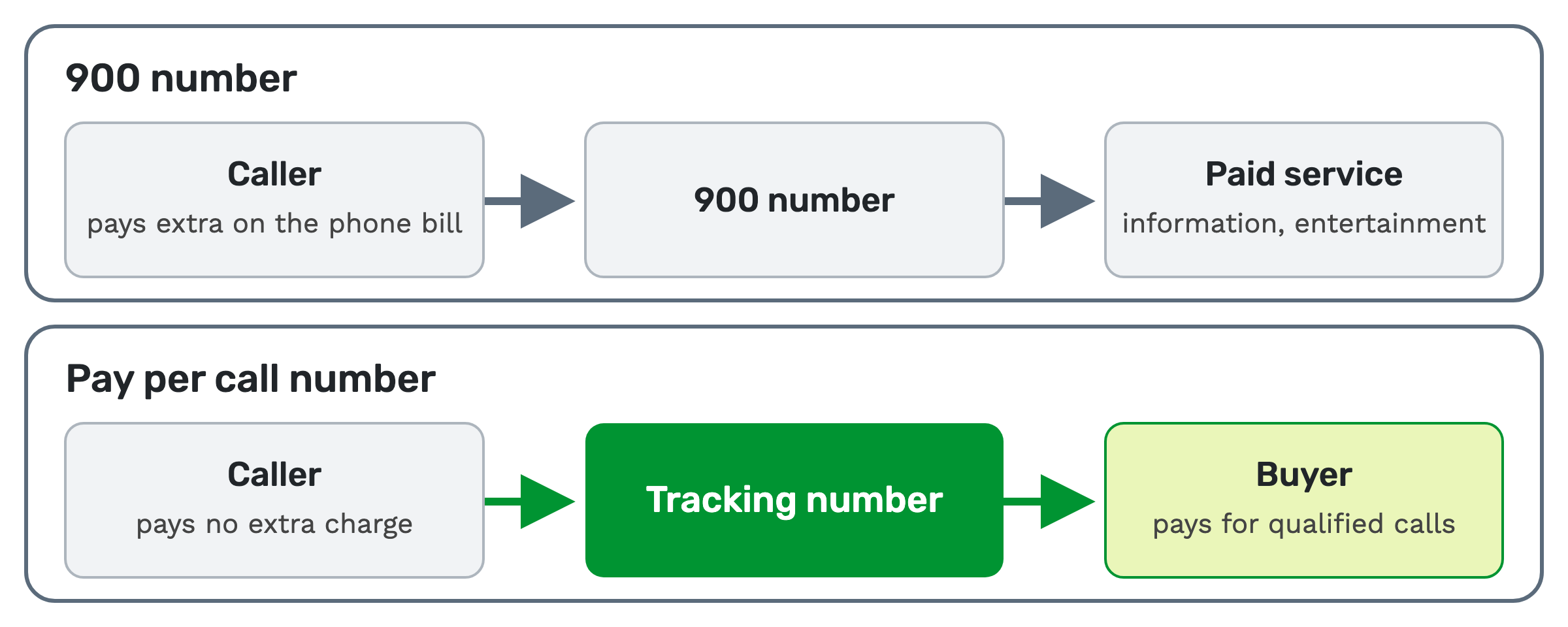
A pay per call number is a tracking number: the caller pays no extra charge, and the business that buys the call pays for it.
It is not a 900 number, where the caller pays a charge on their phone bill for a paid information service. Looking for that? The FCC's guide to pay-per-call services is the place to start.
What is a pay per call number?
A tracking number is a phone number that belongs to one publisher and one campaign. A publisher is the partner that runs the ads and sends you calls.
When someone dials it, the platform looks up the offer behind the number and starts the call flow. An offer is the campaign the call belongs to. A buyer, the business that takes the call, is then picked by routing rules.
To the caller, it looks like any other number. What is inbound call tracking? covers what gets recorded on each call. This page covers getting the number and paying for it.
Pay per call number vs 900 number
The test is one question: who pays, the caller or the buyer?
| Pay per call number | 900 number | |
|---|---|---|
| Who pays | The buyer | The caller |
| How it's charged | Per qualified call, under the deal | An extra charge on the caller's phone bill |
| What's being sold | The call, to a business | Information or entertainment, to the caller |
| What governs the charge | The deal between buyer and seller | Federal rules on premium-rate services |
The two share a name. Pay per call as a marketing model is a different thing from the phone-bill service.
The FCC says callers to those services "either pay an additional charge per-call or are billed at a per-minute rate higher than normal phone calls."
The FTC has its own rule on these services, 16 CFR Part 308. It uses the federal definition: a charge above the cost of carrying the call, on a 900 number or another prefix the FCC designates. Ads for these services must state the cost of the call.
That's general education, not legal advice.
Two separate bills sit behind each number
The first bill is for the call. A buyer pays for each call that meets the agreed rules. That's the revenue on the call. What the publisher earns for it is the payout.
The second bill is for the number. Whoever holds it on a platform pays the platform's rates: a monthly rate per number and a rate per minute.
TrackDrive records revenue and payout on each call. It doesn't pay anyone out.
Local or toll-free?
Call tracking numbers come in two types on TrackDrive: local and toll-free. There's no further split into mobile, landline or VoIP.
A local number carries an area code tied to a place. A toll-free number starts with a prefix such as 800, 888, 877, 855, 844 or 866. The call tracking page lists thousands of both, "in virtually every area code".
Either works for tracking, so decide by the campaign:
- Local fits when the ad is about one place and you want that area code on it.
- Toll-free fits when one number has to cover a wide area and no single area code makes sense.
Don't assume either type converts better. If it matters to your campaign, test both and compare.
How to get a pay per call number
There are three routes. The right one depends on which side of the deal you're on.
- You send calls into someone else's campaign. The number can come from the network or buyer running it, so ask them first. With ping-post, the post itself returns a tracking number.
- You run the campaign. Buy numbers on your call tracking platform and attach each one to an offer and a source. The steps are below.
- You bring your own account. On TrackDrive, you can link your own Twilio, Plivo or Telnyx account and import its numbers in one click. You can also route your own carrier in over SIP, a standard way to carry calls over the internet.
Bring-your-own numbers on a linked Plivo, Twilio or Telnyx account run through your own carrier. The calls still run through TrackDrive's billing: they're billed per minute, each connected number has a monthly fee, and texts are billed too. TrackDrive still handles the routing and call processing.
Step by step on TrackDrive
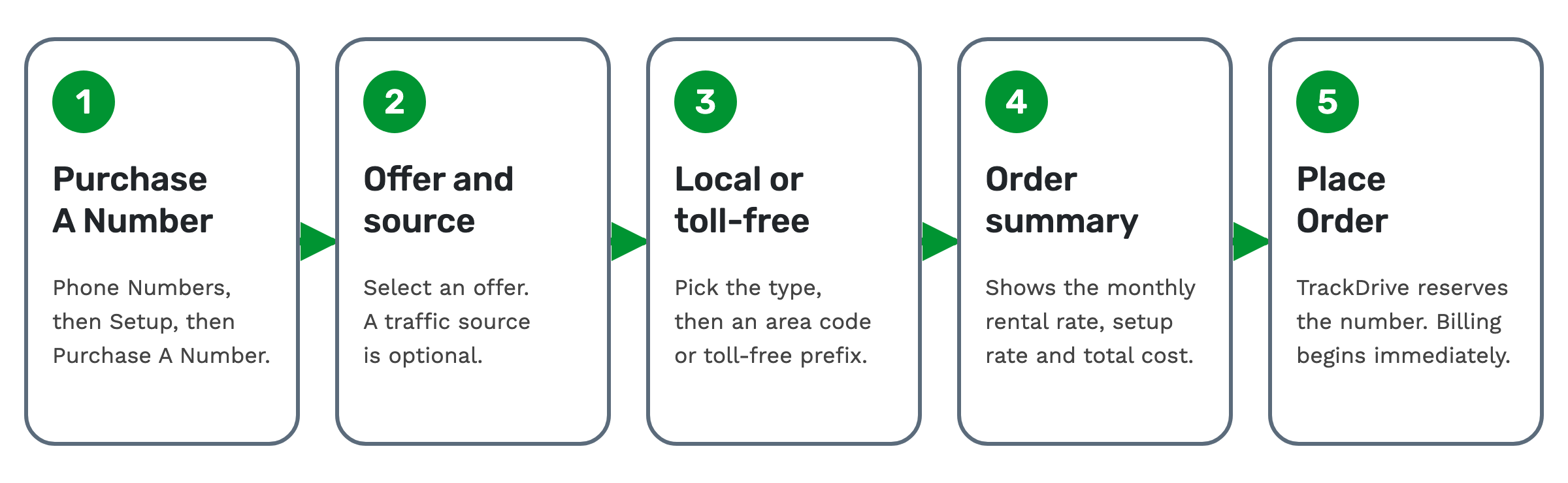
Here's how to set up a pay per call number on TrackDrive, in the order the guide to buying a tracking number gives.
- Purchase A Number. Go to Phone Numbers, then Setup, and click Purchase A Number.
- Offer and source. Select an offer, which decides how inbound calls are routed. A traffic source, the record for whoever sends the calls, is optional.
- Local or toll-free. Choose Toll Free Number or Local Number, then select an area code or toll-free prefix.
- Order summary. It shows "the monthly rental rate, setup rate, and total cost". Read it before you confirm.
- Place Order. TrackDrive reserves the number at the provider, and billing for the rental begins immediately.
 The number then appears under Phone Numbers, then Setup. Its detail page shows the number, the provider and the routing destination, and the guide says it's ready to receive calls at that point.
Before any traffic arrives, make a test call. Dial the number from any phone, let the call complete, and answer the buyer's side if the offer routes to a buyer.
Then open the newest entry in Calls, then Call Logs. It shows the call's status and which buyers were tried.
How many numbers you need
Start with one number per publisher. If two publishers share a number, nobody can prove who sent a call.
You can go finer than that. One offer can have many tracking numbers, each carrying different attribution tokens. An attribution token is a named value that says where a call came from, such as its traffic source.
Fixed numbers suit ads, mailers and TV spots. A website needs something else: dynamic number insertion swaps the number on the page to match each visitor's source.
The common mistake is one number across every campaign. It saves a monthly rate and loses the answer to which campaign worked.
What a pay per call number costs
These are the pay-as-you-go rates on the TrackDrive pricing page, as of 9 Nov 2026, for numbers you buy on TrackDrive.
| Line | Pay-as-you-go, as of 9 Nov 2026 |
|---|---|
| Phone number | $4.00 a month per number |
| Local tracking | $0.055 a minute, rounded up to the full minute |
| Toll-free tracking | $0.060 a minute, rounded up to the full minute |
The tracking rates include forwarding the call to your buyer over toll-free or SIP; international and premium rate centers can add cost.
Forwarding to a buyer's local number costs more. The page's calculator shows $0.010 a minute for a local leg against $0.005 for toll-free or SIP. So a local call forwarded to a local number is $0.060. A leg is one party's side of a call.
It's $0.025 for an inbound call that can't be routed and is rejected. Committing $50 to $8,000 a month lowers the number, tracking and rejected-call rates. There's no onboarding fee.
An invented example, at the same rates: one local number and 1,000 billed minutes in a month. Every call is forwarded over toll-free or SIP. That comes to $4.00 plus $55.00, or $59.00.
That counts only the monthly rate and the minutes. The order summary shows "the monthly rental rate, setup rate, and total cost" before you place the order.
Questions people ask
How do I get a 900 pay per call number? A 900 number is a premium-rate service with its own federal rules, and TrackDrive's numbers are local or toll-free. Start with the FCC's guide. If you want to sell calls to businesses, you don't need one.
Does the caller pay to call a pay per call number? The caller pays only what an ordinary call costs on their own plan. The buyer pays for qualified calls.
What is a tracking phone number? A phone number assigned to one source, so the number a caller dials tells you where the call came from.
Should I use a local or toll-free number? Either works for tracking. The difference is the rate, and whether you want one area code on the ad.
Can I use my existing numbers? Yes, if they're on a linked Twilio, Plivo or Telnyx account. You can also route your own carrier in over SIP.
Should SEO, PPC and affiliate traffic each get their own number? Yes. Give each source its own number, and each call is tied to the source that sent it.
How do I check where a tracking number routes? Open its detail page, which shows the routing destination. Then make a test call and read the routing timeline in the call log.
What happens to call history if I delete a number? It's kept. A deleted number is soft-deleted, so its link to past calls is preserved.
See it in action
Request a demo for a live walkthrough tailored to your use case, or start free, with no credit card and no onboarding fee.