What is ping-post? How real-time bidding for calls works
Ping-post is a real-time bidding method that sells an inbound call or lead to the best eligible buyer before the call connects. The publisher asks for bids from every eligible buyer, and the call goes to the winning offer.
It takes two requests. The ping collects bids. The post commits the call to the winner.
Why ping-post exists
Without ping-post, a call routes to a buyer chosen in advance at a fixed payout. That buyer gets the call even when another buyer would have paid more for that exact caller.
Ping-post puts every eligible buyer in an auction for every call. More buyers competing means higher fill rates and more revenue per call.
How ping-post works, step by step
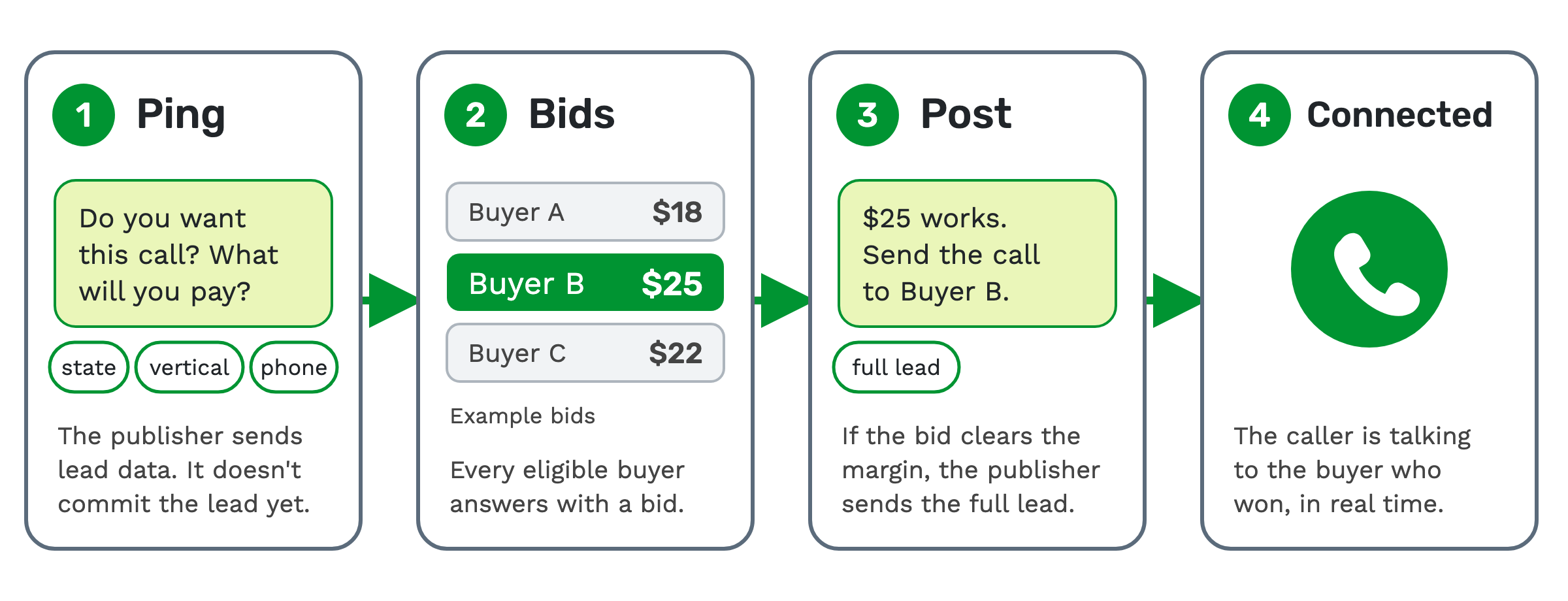
1. The ping. The publisher, or traffic source, sends a ping. A ping is a request that carries the lead data buyers bid on, such as the caller's state, the vertical and a Jornaya token. By default it also carries the caller's phone number. It doesn't commit the lead. It asks each buyer: do you want this call, and what will you pay?
2. The bids. TrackDrive shops the ping to every eligible buyer and collects their bids. Static bidders answer at a fixed price. Live bidders return a new bid by webhook on every ping. Both compete in the same auction.
3. The post. TrackDrive returns the winning bid, or a list of bids, to the publisher. If the winning bid clears the publisher's margin, the publisher sends the post: the full lead, referencing the original ping's ID.
4. Connected. The post returns a tracking number, and the caller connects to the winning buyer.
The whole exchange happens in real time.
Why the bid comes back first
TrackDrive returns the bid instead of committing the call automatically. That lets the publisher check the bid against their own margin floor before they send the full lead.
For simpler integrations, auto-commit is also supported.
What gets checked before a buyer can bid
Not every buyer sees every ping. Buyer matching checks each one against:
- Hours. Is the buyer open right now?
- Caps. Has the buyer hit one of its caps?
- Geo. Does the caller's location match the buyer's targeting?
- Filters. Does the call match the buyer's filters?
- Duplicates. Is this caller a duplicate for the buyer?
When the offer has DNC rejection turned on (it's off by default), pings are DNC checked too.
How the winner is picked
You choose how TrackDrive ranks eligible buyers. There are three methods. Each buyer has its own setting, so buyers under the same offer can use different methods.
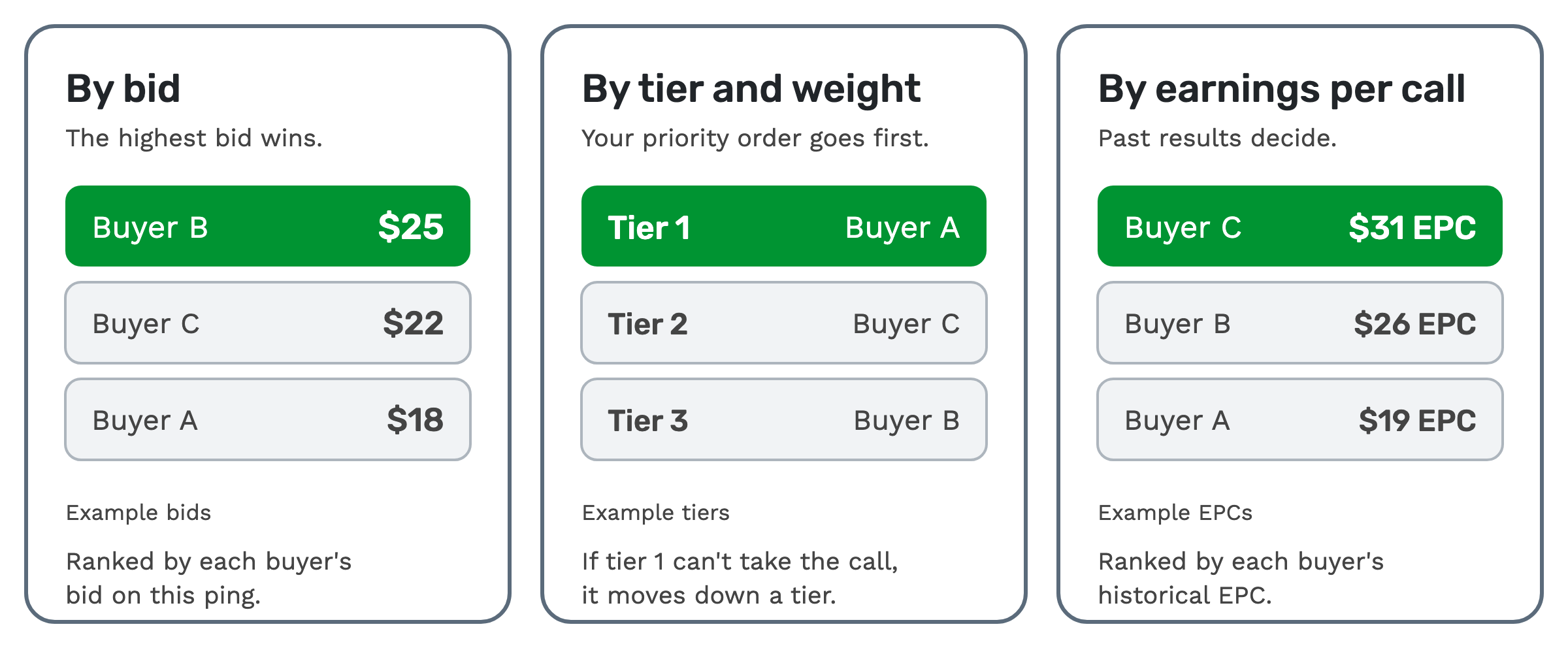 - By bid. The highest bid wins.
- By tier and weight. Tier 1 buyers are tried before tier 2. Within a tier, a higher weight wins more often.
- By EPC. EPC, or earnings per call, ranks buyers by what calls have historically earned with them.
If the top buyer can't take the call, it cascades to the next one. This is buyer waterfall routing: the call moves down the tiers, in bid and priority order, until it connects.
Per-buyer ping caps protect small buyers
A per-buyer ping cap limits how many pings each buyer receives per minute, per hour or per day. You set only the intervals you want. A buyer at its cap is skipped instead of flooded, so partners with limited capacity stop rejecting when your traffic spikes.
Ping-post vs direct post
In ping-post, the publisher pings first and posts second. In a direct post, the publisher skips the ping and posts the full lead straight away.
Direct post is simpler, but there's no auction. Ping-post adds one request and lets buyers compete. TrackDrive supports both: post-only mode skips the ping and submits leads directly by POST.
Who uses ping-post
- Publishers use it to have buyers compete for every call they send.
- Buyers use it to bid only on the calls they want, at the price each call is worth to them.
- Networks use it to run the auction between both sides and track margin for each publisher and offer.
What you see while it runs
TrackDrive measures every ping. A live log shows each ping, the buyers it matched, the winning bid and the accept or reject outcome. Per publisher and offer, you see pings, accept rate, conversions, revenue, payout and margin.
What it costs on TrackDrive
Ping-post is billed per 1,000 unique pings, and posts are billed at the same rate. A duplicate ping within 15 seconds counts once. There's no onboarding fee. See TrackDrive pricing for commit plans.
Questions people ask
Is ping-post only for leads? No. TrackDrive runs the same bidding for inbound calls: the post returns a tracking number, and the call connects to the winning buyer.
Who sets the bid? A live bidder sets its own: it returns a bid on each ping. A static bidder has a fixed price, saved on the buyer's record in TrackDrive.
What does a publisher need to integrate? Four things: the ping URL, the post URL, the company access token, and the list of expected fields from the offer's posting instructions. The ping-post integration guide has the details, and the support article covers what to hand a traffic source.
Can TrackDrive ping-post with other platforms? Yes, with some. TrackDrive can ping a Ringba buyer's RTB endpoint, and a Ringba Ring Tree can ping-post to a TrackDrive buyer. The support site has a guide for each.
See it in action
Request a demo for a live walkthrough tailored to your use case, or start free, with no credit card and no onboarding fee.